
We get asked what whisk to buy on Amazon more than almost anything else. Our answer is the same as always: if you’re in Chicago, buy from a shop that carries real tea gear, not a random Amazon listing — Match | A, Sugoi Sweets, and Chicago Tea House all stock chasen alongside the rest of their matcha tools.
But if you’re not in Chicago, or you need one by tomorrow, here’s what’s actually worth buying — and, more usefully, why you should stop shopping around.
For the impatient:
Best all-around: a plain light-bamboo 2-pack (on Amazon) — around $10
Best single whisk: MatchAiA 100-prong (on Amazon) — around $7
Best starter set (whisk + holder + scoop): TEANAGOO 6-piece with black holder (on Amazon) — around $8
Best way to learn the difference: the 80 / 100 / 120-prong sampler (on Amazon) — three whisks, side by side
Bottom line: buy a 2-pack of ordinary light bamboo and stop researching. Spend the extra 20% on a dark brown one only if you like how it looks. The spec differences between the whisks on this page are smaller than the difference good care makes, and a spare whisk on hand will save you more mornings than any prong count will.
Skip to: Read this first • Local shops • The picks • What to skip • What actually matters
Affiliate disclosure
The links below are affiliate links — if you buy through them, Amazon pays us a small commission, which helps keep this site running.
Nearly every whisk on this page is one we’ve personally used. The few we haven’t, we’ve scouted specifically for this guide — we’re not listing anything we wouldn’t hand to a friend. Where a pick has more than one link, that’s on purpose: whisk listings go in and out of stock constantly, and prices and delivery times move around, so we’ve included alternates that get you the same thing.
Read this before you shop around
Most of the effort people put into buying a whisk is wasted, and the Amazon reviews are why.
A lot of those reviews come from people who got the whisk free in exchange for writing about it, and a lot of the rest come from people who don’t know what they’re looking at. The recurring example: someone calls a whisk brittle or cheap because tines snapped off — when the real problem is that their bowl is too small, or they’re scraping the bottom of it, or they left the whisk soaking in the sink. That’s not a defective whisk. That’s a whisk being used the way whisks break.
Here’s the honest version. Nearly every whisk on this page carries the same risks. They are bamboo, they are made cheaply, and they will all eventually wear out. That isn’t a scandal — it’s what a chasen is. Treat it like a consumable, not an heirloom, and the entire buying decision gets easy:
- If you’re mostly making lattes, get a basic whisk — and get a 2-pack. The second whisk is the whole trick. There will come a day you need a new whisk before you were ready to order one, and having the spare in the drawer costs a few dollars.
- Get the dark brown one if you like how it looks and don’t mind spending about 20% more. That’s the entire case for it. It isn’t a performance upgrade.
- Don’t waste time comparing listings. The difference between two $10 whisks is smaller than the difference between a whisk you rinse and dry properly and one you don’t.
Cared for reasonably, any whisk on this page should last you six months to a year, even with near-daily use. The care rules are short: rinse it before and after use, don’t let it soak, don’t submerge it past about halfway up the tines (once water gets into the split in the bamboo, that’s where the tines start weakening), use a bowl big enough that you aren’t scraping the bottom, and store it on a whisk holder.
And no, you don’t need the fancy one. Handmade Japanese chasen are genuinely beautiful — we own a few, we love them, we like using them. But our day-to-day whisking is done with the whisks on this page. A high-end whisk isn’t just “better”; it’s more demanding. A very high tine count is more fragile and wants a gentle hand. A very low tine count in a whisk built for thick tea wants actual skill. If you’re making lattes, a $60 chasen buys you a nicer object and a more breakable one — not a better drink.
If you’re in Chicago: skip Amazon, buy local
Chicago has real shops that carry chasen, not just bowls.
Sugoi Sweets / Mokoma Select Teas
Artisan shop carrying matcha and tools alongside its chocolates and matcha soft-serve. Plenty of reasons to go.
Address: 937 N Ashland Ave, Chicago, IL 60622
Online shop: sugoisweets.com
Match | A
Dedicated matcha shop on Chicago Ave in West Town. Genuinely authentic whisks at surprisingly reasonable prices — worth a visit in person before buying anything on Amazon.
Address: 1857 W Chicago Ave, Chicago, IL 60622
Website: finditmatch-a.com
Chicago Tea House
U.S. outpost of a German company, with a dedicated matcha-tools section. Usually only a couple of whisk options, but for a basic whisk in a hurry it’s a good local option.
Address: 1160 N State St, Chicago, IL 60610
Matcha tools: chicagoteahouse.com
The picks
One thing to know before the list: most of these are Chinese-made. We’re saying that plainly because most listings won’t. It isn’t a knock — they’re well-made enough to do the job, they hold up, and they’re a fraction of the price of a Japanese chasen. It only matters if you’re buying the whisk as an object rather than as a tool, and if that’s what you’re doing, buy from a real Japanese maker rather than an Amazon listing claiming to be one.
The default: a plain light-bamboo 2-pack
What it is: two ordinary light-bamboo whisks, middle of the road on size and tine count.
Price: around $10 for the pair
Why this one: it’s the whisk you should buy, and the honest reason is that nothing more expensive will make your latte better. Two whisks for ten dollars means the day one frays, you aren’t waiting on shipping to make matcha.
Best for: everyone, and especially anyone making lattes and not trying to impress anybody.
Caveat: very likely Chinese-made — we can’t confirm otherwise. It won’t be the prettiest thing on your counter.
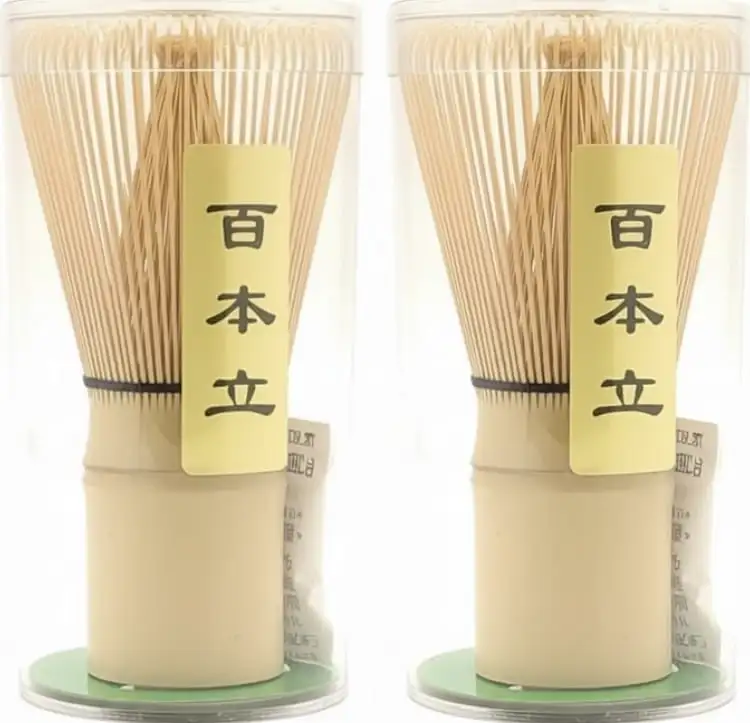
Light-bamboo chasen 2-pack on Amazon →
Need more than two? The same whisk comes in bulk, which is worth knowing if you’re outfitting a café, a class, or a household that goes through them:
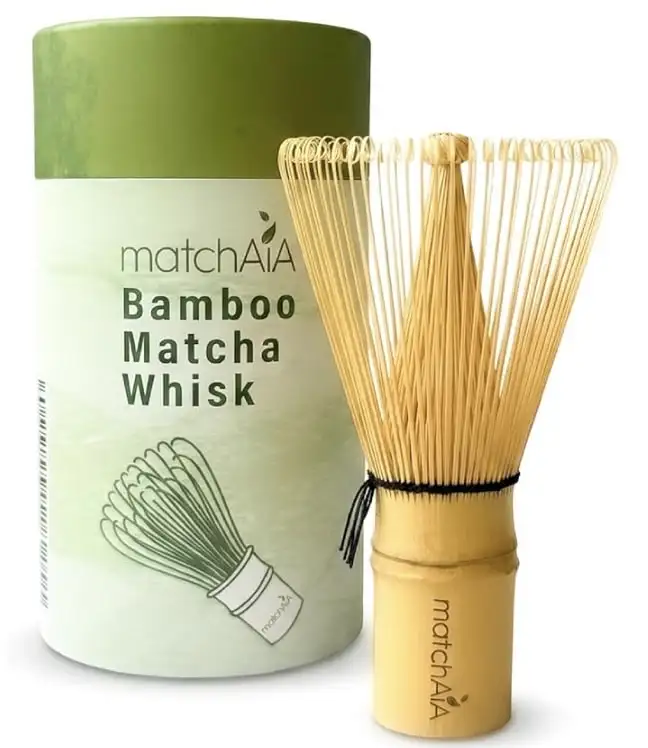
The best single whisk: MatchAiA 100-prong
What it is: a simple, straightforward handmade 100-prong bamboo chasen, sold on its own.
Price: around $7
Why this one: 100 tines is the working default — enough to whisk a smooth bowl of usucha, sturdy enough to survive daily latte prep. At seven dollars there’s nothing to agonize over.
Best for: anyone who wants one good whisk and doesn’t need the spare.
Caveat: it’s one whisk. See above re: the spare.
If you want the holder and tools too
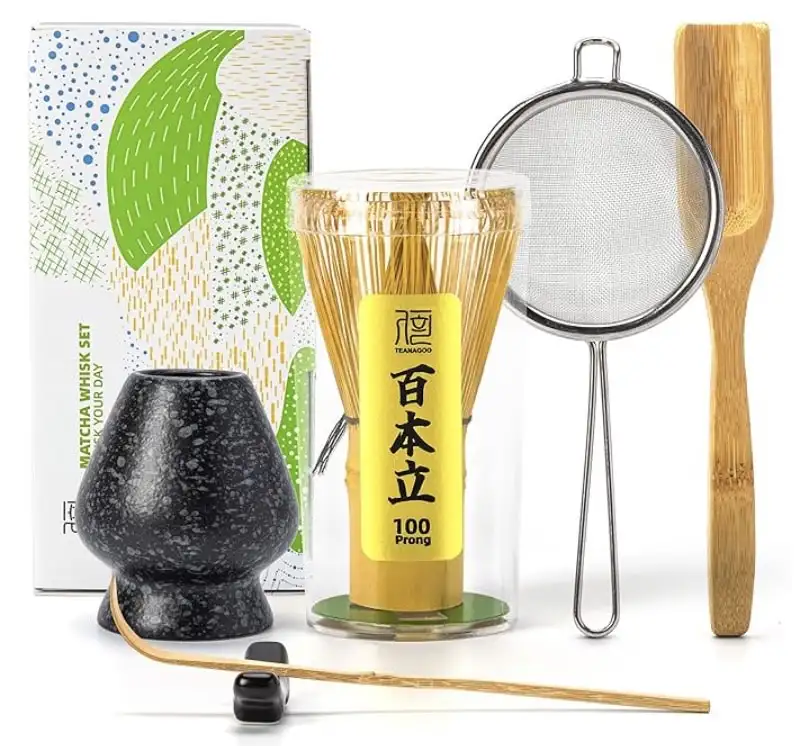
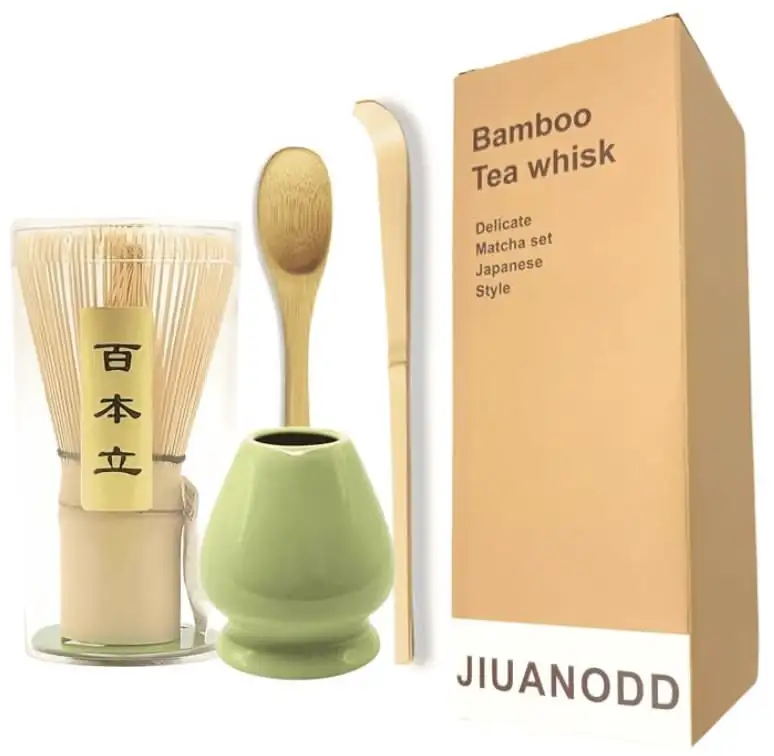
A whisk holder (kusenaoshi) is the one accessory that genuinely extends whisk life — see what actually matters. Rather than buying it separately, it’s usually cheaper to get it in a set:
TEANAGOO 6-piece starter set — around $8 100-prong whisk, black holder, scoop (chashaku), and a sifter. This is the one to get if you want the whole kit in one order.
TEANAGOO 6-piece set on Amazon →
JIUANODD whisk + holder + scoop — around $10 A simpler set: whisk, stand, scoop. Fine option if the TEANAGOO is out of stock.
JIUANODD whisk + holder set on Amazon →
If you want the dark brown one
Buy this because you like the look. That’s a completely legitimate reason and we’re not going to pretend it’s a performance upgrade — dark bamboo is denser and a little sturdier, but it doesn’t foam better, and the difference won’t decide anything about your morning.
100-prong purple bamboo, two-tone — around $12–15 (about 20% more than the light version) Handsome whisk, natural dark grain. Likely Chinese-made.
Purple-bamboo 100-prong, two-tone, on Amazon →
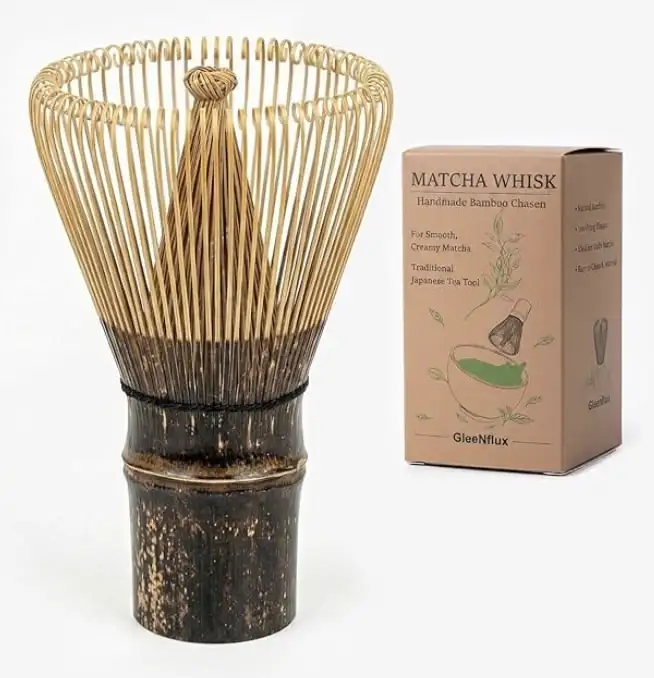
Prefer a lower tine count? 80-prong dark bamboo is another good-looking brown whisk, sturdier with a bit less foam — and there’s a
100-prong version of the same whisk.
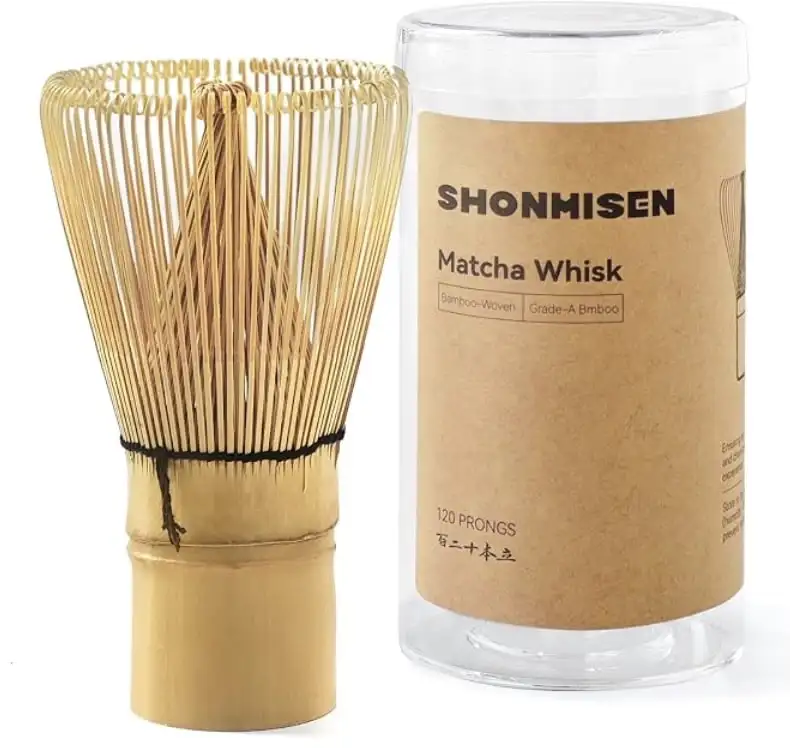
For straight matcha: SHONMISEN 120-prong
What it is: 120 tines (80 + 80 construction), the finer end of the standard range.
Price: around $10
Why this one: more tines break up more powder, which shows up as a finer, more stable foam on a straight bowl of usucha. Nothing fancy about this particular whisk — it’s Chinese-made — but it’s held up well for us.
Best for: usucha drinkers who already have their technique down and want the foam a step finer than a 100-prong gives.
Caveat: thinner tines flex and split more easily, so it wants a lighter hand. And if you’re mostly making lattes, the extra fineness disappears into the milk — skip it.
To actually learn the difference: the 80 / 100 / 120 sampler
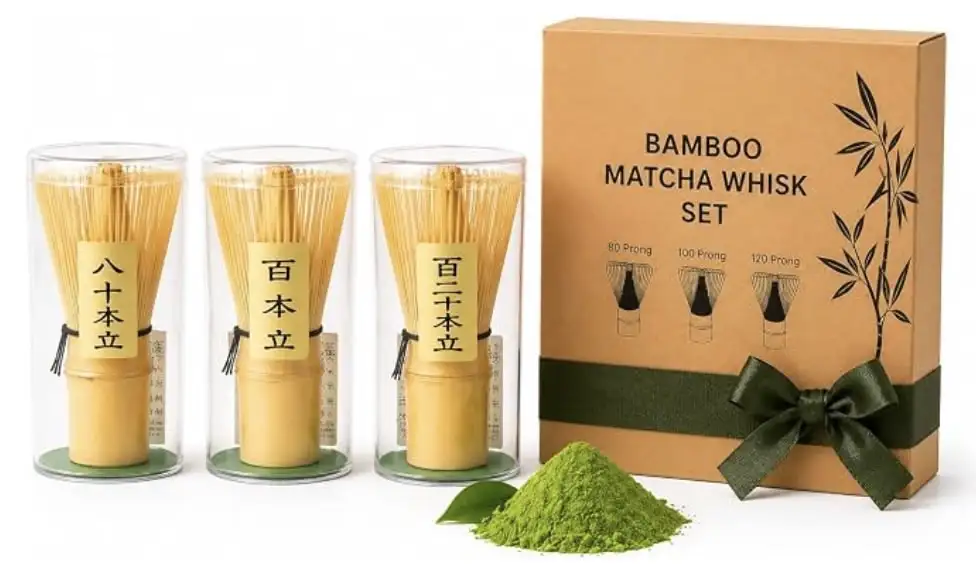
What it is: three chasen in one kit — 80-prong, 100-prong, and 120-prong.
Price: around $20
Why this one: this is the most useful $20-ish on the page. It’s one of the top links I send to people really interested in learning. Reading about tine count teaches you nothing; whisking the same bowl three times with three whisks teaches you everything. You feel exactly how a thin tea, a thick tea, and the middle-of-the-road whisk behave in your hand and in your bowl.
Best for: anyone curious enough to be reading a whisk buying guide this far down.
Caveat: these are cheap Chinese versions. They’re plenty good enough to get the job done and to make the comparison honestly — they’re just not showpieces.
The one we didn’t expect to love: a long-handled whisk
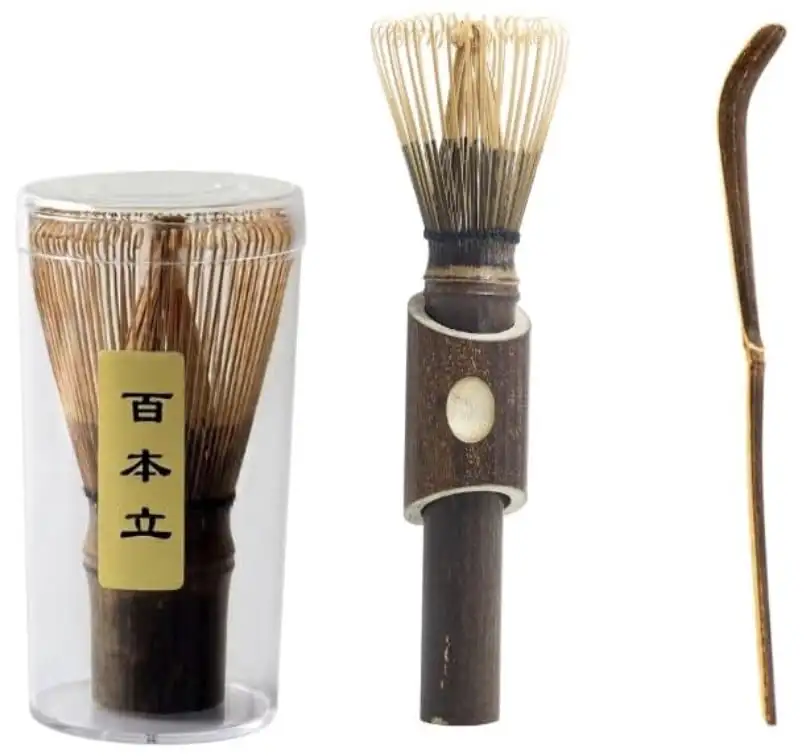
What it is: a chasen with a long, narrower handle, sold here alongside a standard short whisk.
Price: around $12–16
Why this one: this started as a winter thing — a long handle reaches the bottom of a taller bowl without putting your knuckles in the tea — and then stuck around long after winter, because it’s genuinely comfortable. The handle is slimmer than a standard chasen without being cramped. Not the first whisk to buy, but not a gimmick either.
Best for: tall bowls, tall glasses, and anyone who’s found standard chasen handles a little stubby.
Caveat: likely Chinese-made. And if this is your first whisk, buy a standard one first — a long handle solves a problem you haven’t had yet.
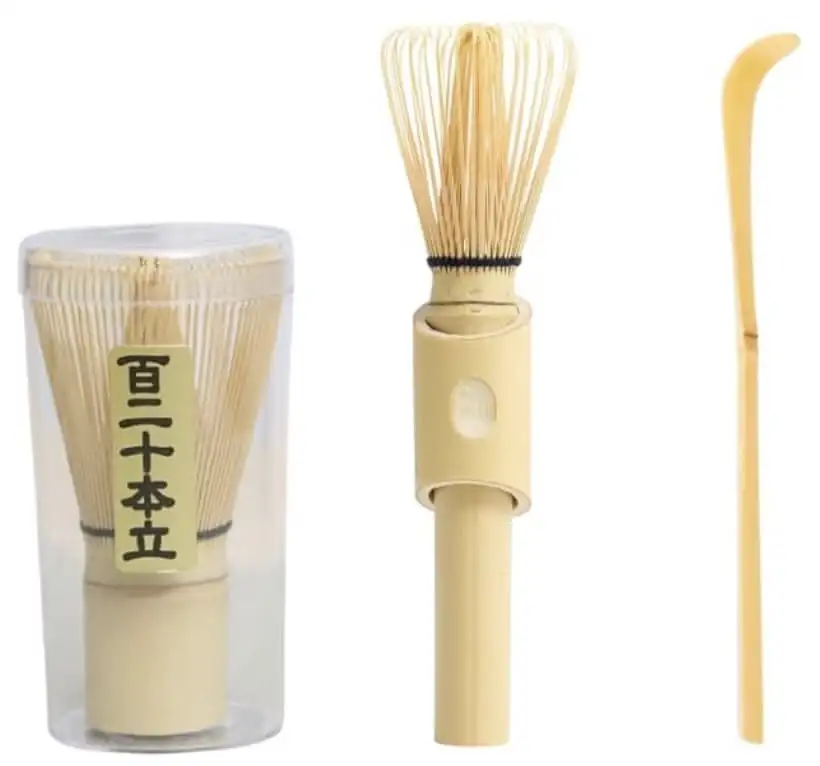
Long-handle + standard whisk set on Amazon → Comes in dark or light.
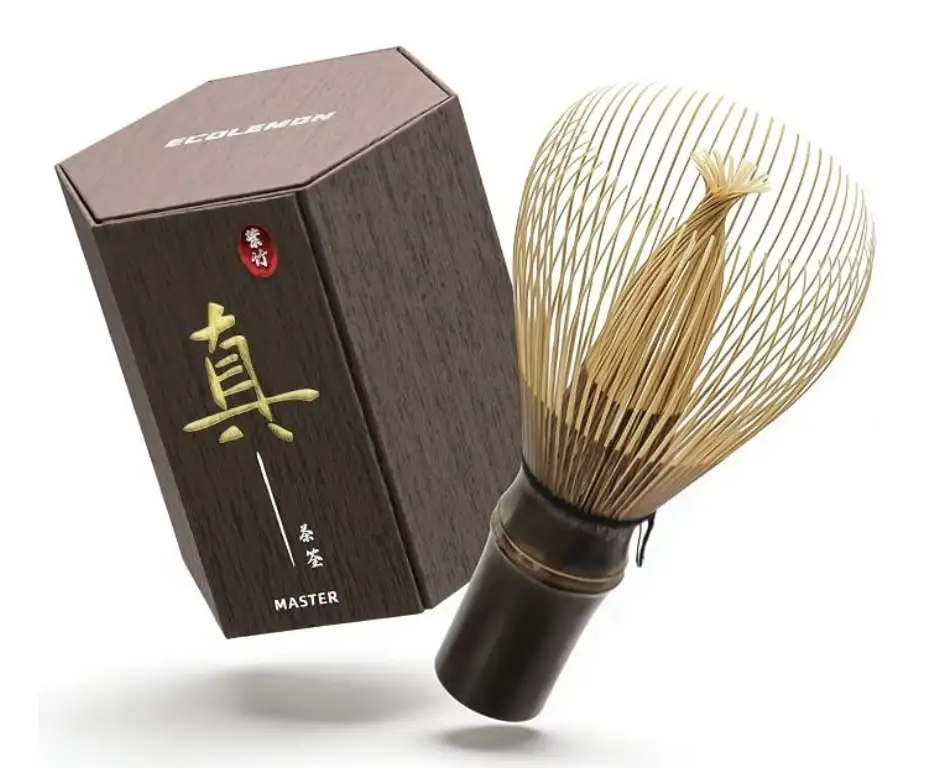
If you want to go fancier without going all the way: ECOLEMON kurotake shin chasen
What it is: a handmade dark-bamboo (kurotake) whisk with a low tine count — roughly 70–76 — and a shorter handle. Origin: China.
Price: around $15–20
Why this one: the step up that isn’t a trap. The short handle is easy to grip, and the low tine count means it’s built for thick tea (koicha) and forgiving of a heavy hand — which makes it a surprisingly good pick for a beginner, or for anyone who knows they’re rough on whisks.
Best for: koicha, and anyone who wants a nicer object without inheriting the fragility of a high-tine-count showpiece.
Caveat: fewer tines means less foam. If you want a fine usucha foam, this isn’t it.
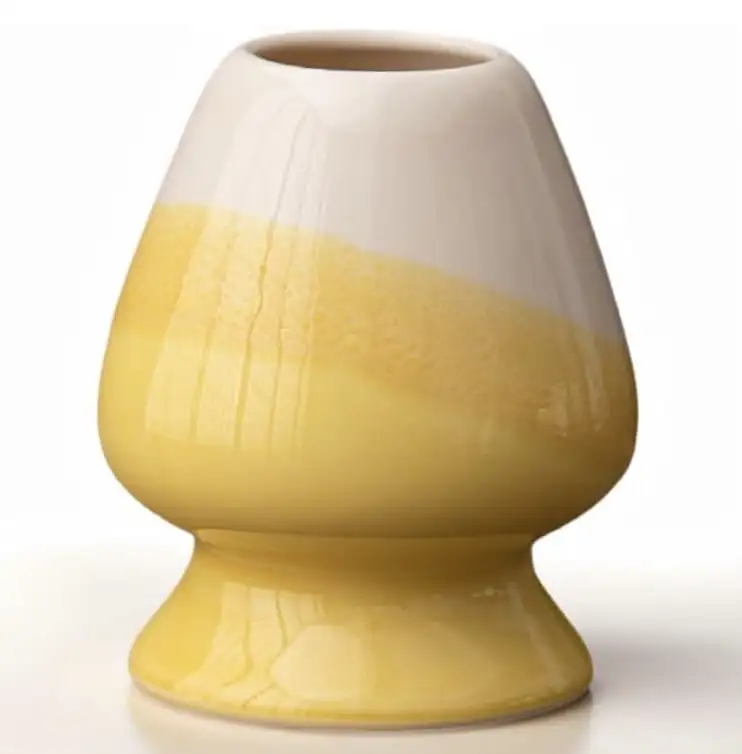
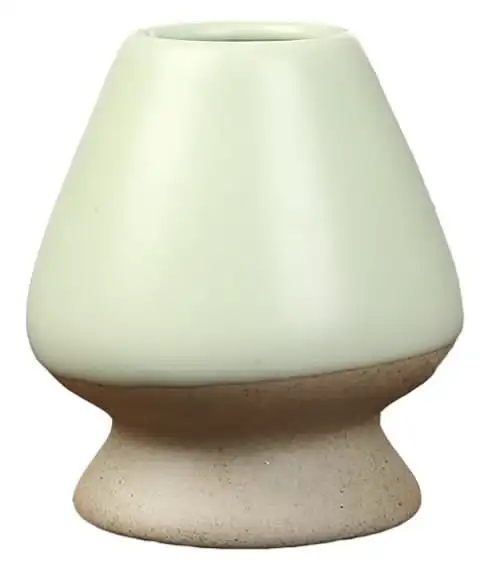
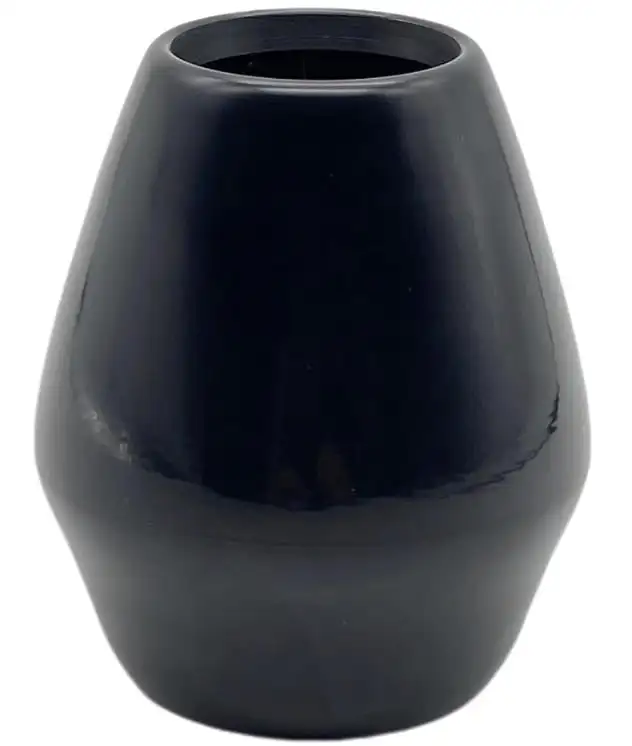
Ceramic kusenaoshi (whisk holder), on its own
What it is: a small ceramic stand that holds a wet chasen tines-up between uses and gently presses the tines back into their curve as it dries.
Price: around $8–14
Why this one: a chasen dried flat on a towel dries slower and splays outward over time; one dried upright in a kusenaoshi holds its curve longer. It’s most of the gap between a whisk lasting four months and one lasting close to a year.
Best for: anyone whisking three or more times a week. If a set above already includes a holder, you don’t need this.
Caveat: skip it if you whisk a few times a month — drying tines-up on a clean towel does nearly as well at that pace.
My personal favorites:
- Nwstar ($10) because of the glaze+colors
- This half glazed+matte one ($8)
- This actual Japanese unbreakable one ($20)
What to skip
⚠️ The research. We mean it. The single most common mistake is spending an hour comparing listings whose real differences are smaller than the effect of rinsing your whisk properly. Buy the 2-pack.
⚠️ Sub-$15 “authentic Japanese chasen” listings with no prong count in the title. Everything on this page is cheap, so this isn’t snobbery about price — it’s that a listing hiding its prong count is hiding something. Common problems: the real tine count is lower than the photos imply, the tines are cut unevenly instead of split, and the handle joint is glued rather than carved from one piece of bamboo — which puts the weak point exactly where the tines meet the base, under wet-whisking tension.
⚠️ Anything marketed as a “ceremonial-grade whisk.” Matcha powder gets graded (sorta) — ceremonial vs. culinary can be a real distinction, and a listing describing the powder it’s meant for is fine. But there is no ceremonial grading system for chasen. A whisk claiming that grade for itself is borrowing credibility from a term that doesn’t apply to it, which tells you something about the listing.
⚠️ The expensive handmade Japanese chasen — for now. Not because it’s bad. But because it asks more of you than a $10 whisk does, and it will not improve a latte. Buy it later, on purpose, because you want it — not as an upgrade you think you need.
What actually matters when you’re buying a chasen
Care — that’s what helps your whisk more than any spec on this page.
- Rinse the tines in plain water before and after use — no soap, which strips the bamboo. And don’t soak it in water. A minute is fine, but don’t leave it soaking.
- Don’t submerge it more than halfway up the tines: once water gets into the split in the bamboo, that’s where the tines start losing strength, and how mold can grow.
- Use a bowl big enough that you aren’t beating your whisk against the sides nor scraping the bottom with the tips.
- Let it air dry. Place it on a kusenaoshi (whisk holder/stand) if you have one, then walk away. If not, dry it tines-up with airflow around it or, as a last resort, lay it gently on it’s side on a towel. No need to ever place it back into the plastic tube it came in, unless you’re traveling with it. (And even then be gentle, it never fits fully back into the tube once it’s been used.)
Do that much and a daily-use whisk lasts six months to a year.
When to get rid of your whisk? If it develops mold, it’s done — you can’t clean mold back out of bamboo, and it isn’t worth trying. Also, if you start noticing tines breaking off into your matcha, well then it might be time to make sure you’re not scraping the bottom of the bowl, and then get a new whisk if you don’t like picking bamboo out of your teeth, or if you have guests :)
Tine count. The tines aren’t decorative — the outer ring aerates the water into foam, and the inner ring breaks up clumps the powder didn’t sift out.
- An 80-prong whisk is the sturdiest and simplest: less foam, but it holds up, and it’s genuinely meant for koicha (thick tea), which isn’t whisked into foam anyway.
- 100-prong is the working default — real foam, reasonable durability.
- 120-prong pushes the foam finer for usucha (thin tea), at the cost of tines that flex and wear faster.
More prongs is not necessarily better; it’s a trade between foam refinement and how much care the whisk demands. If you want to actually feel this rather than take our word for it, the 3-whisk sampler is the cheapest way to.
Bamboo type. White bamboo (shiratake) is the standard, cheapest option and what most Amazon listings are made from. Black/purple bamboo (kurotake) is denser and harder to carve, which makes a sturdier whisk — not a better-foaming one. Smoked bamboo (susudake), cut from bamboo that spent decades absorbing smoke over a traditional hearth, is a real and distinct material, but it’s rare enough now that you’re unlikely to find it on Amazon at all. A cheap listing claiming susudake is telling on itself.
Where it’s made. Most affordable Amazon chasen are Chinese-made, including most of the ones on this page, and most listings won’t say so. They work. The reason to buy a Japanese-made chasen is that you want a Japanese-made chasen — which is a fine reason, just not a functional one for a daily latte.
Wire whisks and electric frothers aren’t worse — they’re a different tool for a different job. A chasen’s fine bamboo tines are built to work matcha and hot water into a stable, fine-bubbled foam; a metal wire whisk or an electric milk frother isn’t designed to do exactly that and so your results will vary widely. Where they earn their keep is the opposite job: a frother moves through steamed milk easily, which a chasen’s thin tines don’t — they’re sized for water, not milk, and tend to clog rather than foam.
Do you need a chasen (whisk) to make matcha? If the daily order is a latte then you might not. A milk frother (either handheld or standalone) might be just as good for you. Two main reasons you might want to reach for a chasen: (1) when the matcha is judged on its own — a straight bowl of usucha with 2g matcha and 70ml (2.4 fl oz) water at around 170°F (77°C) is where the bamboo actually matters; and (2) when you want to use it, like for the ritual and process or just for the fun of using it.
If you have chasen thoughts or questions, let us know!
Last updated: July 2026