
You’re reading about a past gathering. Chicago Matcha Club meets every few weeks in Chicago — see what’s coming up next, and grab a seat before it sells out.
We sent this recap to everyone who attended our Chicago Matcha Club meetup. Posting it here so you can see what we’re up to.
Wanna join us next time? Get on the Matcha Club Email List!
RECAP– Chicago Matcha Club #3: Matcha 4 Ways
Our final summer gathering explored how a single cultivar transforms across four distinct preparation methods
On the last day of summer, we ran two sessions with matcha enthusiasts gathering in Ukrainian Village to explore how the same matcha behaves when prepared in completely different ways.
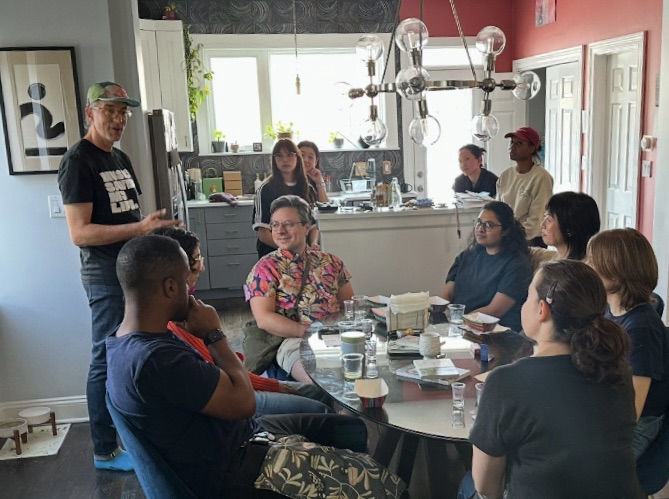
The Matcha: Okumidori from Wazuka
We focused on a single cultivar: Okumidori, sourced directly from a small family farm in Wazuka, Kyoto. The name translates to either “deep green” (reflecting its rich chlorophyll content) or “late green” (referencing its harvest timing)—both interpretations have merit in tea terminology.
Depending on the year, Okumidori ranks as the 3rd or 4th most common cultivar in Japan at 3.4% of tea cultivation, behind Yabukita (67.6%), Yutakamidori (6.2%), and Saemidori (4.3%). It’s a hybrid of Yabukita and Shizuoka Native #16, registered in 1974 by Japan’s Ministry of Agriculture. The cultivar is known for strong cold tolerance and harvests 6-8 days after Yabukita.
Flavor profile: High umami with low bitterness, creating what experts describe as a well-rounded, clean, refreshing tea with distinctively bright green color when brewed.
The Format: Four Preparations
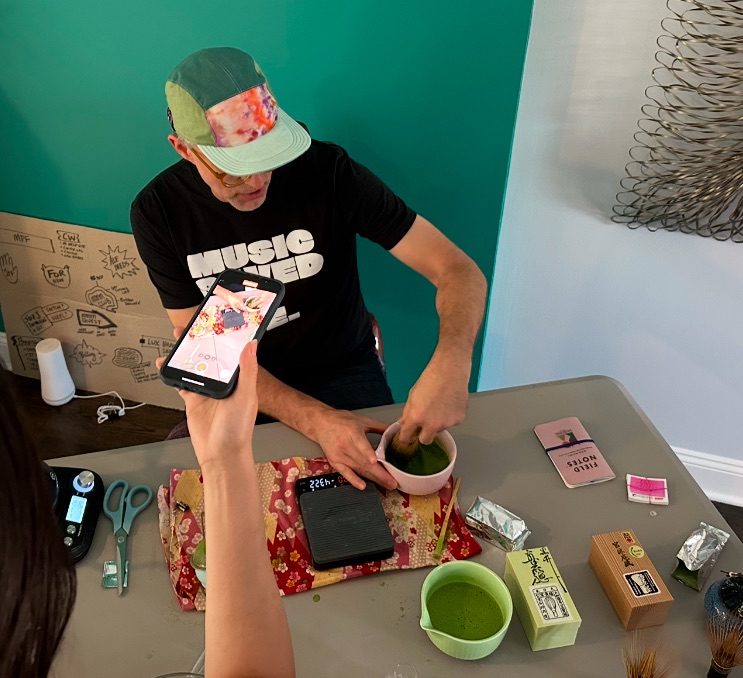
1. Usucha (Thin Tea) – Traditional
2g matcha, 60ml water at 175°F
The standard preparation—whisked vigorously to create foam. This served as our baseline for understanding the tea’s fundamental character.
2. Koicha (Thick Tea) – Ceremonial
4g matcha, 30ml water at 168°F
Double the matcha, half the water. Whisked slowly to avoid air incorporation, this dense, paste-like consistency sits on your tongue longer, revealing layers of flavor—particularly that characteristic bitterness that acts as structural support rather than a flaw. A few folks were surprised by how much they liked it… others, not so much :)
3. Sparkling Water Version – Refreshing
4g matcha, 65ml water, over ice with 125ml sparkling water
We prepared a concentrated base and poured it over either Maison Perrier or Mineragua. The carbonation’s CO2 reduces the perception of bitterness and astringency through chemical interaction with matcha compounds, creating something crisp without added sugar.
4. Oat Milk Latte – Modern
4g matcha, 65ml water, 125ml Chobani oat milk
The contemporary classic. Beta-glucans in oat milk (ranging 2-8% by weight) bind to tea polyphenols through hydrogen bonding and hydrophobic interactions, fundamentally reducing bitterness perception. Scientific studies confirm measurable adsorption between polyphenols and β-glucan, affecting both taste and bioavailability. (It’s called googling and those were the sources… I don’t actually understand it all.)
Technical Insights We Discussed
Particle Size Matters: Premium matcha is ground to 10-15 microns (μm) for proper foaming and smooth mouthfeel. Home grinders often can’t achieve below 20 microns, affecting texture and mixability—essentially doubling the particle size compared to professional stone mills.
Temperature Variables: We used 175°F as standard, though some nicer matchas turn bitter at higher temps while others need heat to express themselves. Okumidori’s high chlorophyll content (responsible for its deep green color) actually correlates with lower astringency compared to cultivars with less chlorophyll.
The Starbucks Effect: While it’s true that Häagen-Dazs Japan introduced Green Tea Ice Cream in the late 90s, the craze really didn’t hit Western markets until the mid-2000s. The Western matcha latte trend traces back to Starbucks’ April 2006 launch of their Green Tea Latte, which contained 51% sugar by weight. The company only eliminated sugar from their matcha powder in early 2025, lifting sales by nearly 40%. Starbucks provides mass public education by introducing people to ingredients they’ve otherwise never encountered. This popularization fundamentally changed Western matcha economics and has now drastically affected farming practices in Japan.
What We Learned
The contrast between koicha and the milk version was striking. The thick tea’s intensity—borderline overwhelming, yet pure bliss to some of us—became well-balanced when cut with oat milk. The bitterness that seemed harsh in koicha worked as structural support in the latte, carrying the flavor through without dominating.
The sparkling version packed an odd surprise. The carbonation created a bright, almost citrusy quality that made the matcha feel lighter without diluting it. One participant noted that adding lemon causes the matcha to brown faster and even appear to curdle slightly due to acid interactions.
What’s Next
We’re planning our next session for October 19th, likely exploring the Yame region’s matcha alongside its sibling loose leaf teas, namely the flagship gyokuro and sencha.
Sign up at needmatcha.com/chicago-matcha-club for early access to tickets.
Special thanks to everyone who joined us for the final summer session, and to Meghan (and Alfie) for graciously sharing the space.
Additional References
- Tea Nursery cultivar documentation: Okumidori registration (茶農林32号, 1974)
- Wang et al. (2013), “Effects of molecular structure of polyphenols on their noncovalent interactions with oat β-glucan,” Journal of Agricultural and Food Chemistry
- Malvern Panalytical particle analysis specifications
- Starbucks Q2 2025 earnings report (CEO Brian Niccol)