Call me a heretic, question my sanity, even revoke my Matcha Club card, if you must, but the time has come to propose an extraordinary challenge:
I want you to drink less matcha… for peace.
Yes, I know. Bold words for someone who runs a matcha blog. (If you landed here from somewhere else and aren’t sure what matcha is, it’s essentially finely ground green tea whisked into hot water.)
When Your Favorite Indie Band Goes Mainstream
Matcha is having a moment. A BIG moment. Popularity has exploded so much that farmers can’t keep up—there’s an actual matcha shortage worldwide.
And honestly? It’s… complicated for me. Like when your favorite indie band goes mainstream. You still love them, but the intimate shows are traded for expensive stadium seats next to drunk loudmouths chatting during your favorite quiet song.
So it is nowadays. We can’t open Instagram without watching people dump unholy amounts of sugar and flavoring into our sacred green lifejuice. But perspective has a way of finding you when you least expect it.
This morning I walked into a coffeeshop, saw news on a TV, and something clicked. While we’re hand‑wringing about matcha shortages, children in Gaza are starving from food shortages. Families in Sudan and Yemen are displaced by war and famine. In Haiti, entire neighborhoods are cut off from food and medicine. And that’s just to name a few.
This is an easy give. So I started this personally today—and I’m doing Wednesdays going forward. I’m inviting anyone in our matcha-lovin’ community to pick their own day and consider it with me
Skip one matcha latte a week—just one. Take that $7.50 and donate it to people working to keep others alive and safe.
If you’re already on board, skip ahead to see how I’m doing this. Otherwise, read on for more about what prompted this…
Resurrecting the Mocha Club
This isn’t even a new idea. In the USA, Christian subculture nailed this back in the early 2000s with the ‘mocha club.’ When I was working at Starbucks obsessing over matcha, the hottest cafe concoction was the mocha latte (think hot chocolate but with a shot of espresso… so… for adults!). I spoke with more than a few customers who were skipping one weekly drink to donate that $5 to famine relief instead. Simple, but effective.
It’s time we resurrect it for this decade’s hottest drink. Because, dammit, there are still children starving.
This realization reminded me of something I learned recently in Japan about tea’s historical role in peacemaking.
What Japan’s Tea Rooms Taught Me About Peace
Last month, I finally made my first pilgrimage to Japan. Toured farms I’d only known through emails, saw the harvest, and met the farmers keeping this global matcha supply churning. Along the way I also learned a few unexpected things—not just about tea, but about peace.
Japanese teahouses traditionally have very small entrances. Maybe you’ve heard the poetic story of warring samurai removing their armor to enter. Making the place for tea a space of peace.
So incredibly beautiful and heartwarming and… also not exactly true.
It’s clear the tiny tea house doors (nijiriguchi) forced everyone to crawl through on their knees—rich or poor, powerful or peasant. Ego? Check it at the door. Dignity? Also, kind of gone.
UCLA anthropologist Herbert Plutschow’s research informs that “Teahuts and rooms became the antipodes of war and violence. They were known to be the only places where members of the leading samurai class left their swords outside.” The armor myth may be a little embellished, but the swords—the actual instruments of violence—had no place in what Plutschow called “a ritual setting of social and political harmony.”
The practice wasn’t about disarmament; it was about dismantling ego. In a society obsessed with hierarchy, the tea room temporarily made everyone equal.
Tea was the great equalizer.
During Japan’s Sengoku, or Warring States, period (1467-1615), tea ceremony became an actual tool for peacemaking and political diplomacy.
In 1568, when the warlord Oda Nobunaga threatened to destroy the city of Sakai, two tea masters invited his generals to tea (matcha, no less!), over which they negotiated peace and prevented a massacre.
People literally used matcha to save people!
We can literally use matcha money to save people!
The Modern Tea Ceremony
Here’s what I’m proposing: a modern tea ceremony that honors both the ancient wisdom and our current global reality. Instead of just consuming matcha, what if our weekly matcha ritual became about contributing to peace?
I’m not asking you to give up matcha entirely. I’m asking you to transform one weekly latte into something sacred—a small sacrifice that connects you to people working for peace around the world.
Since I drink a lot of matcha, I’m supporting both organizations I’ll mention below by setting up recurring monthly donations. I started today by skipping a matcha latte and throwing a tea bag in my water bottle. It wasn’t nearly as tasty. And that was okay with me.
How Can Your $7.50 Help?
I’m recommending two organizations because I’ve personally worked with them and trust the work they do. Gifts to either of them are tax-deductible.
- Red Letter Christians are currently working with local partners providing meals, hygiene kits, clothing, and medical aid in Gaza and surrounding areas. I’ve watched them coordinate relief efforts and provide resources that literally keep families alive during unimaginable circumstances.
- Fellowship of Reconciliation is currently funding interfaith dialogue in conflict zones and legal/counseling support for conscientious objectors who refuse to carry out killings. They’re the kind of organization that works behind the scenes and rarely gets much credit for preventing violence before it starts.
If you have others you’d rather give to… Please, give to them instead! The point isn’t to funnel money to specific organizations—it’s to redirect our small luxuries toward urgent human needs.
$7.50/week = $30/month
I can promise you that this will not end war, but it will help the people who are standing between violence and the vulnerable. I personally know some of those people. I’ve seen the work they’re doing and the impact they’re making. And I know that, especially right now, any little bit helps.
Post Fake Matcha!
IF you’re the type that reaaaalllly needs your Instagram-posting fix just as much as your matcha fix.
I have an idea: post fake matcha!
Since you’re skipping your matcha for a cause, post that. Post a stock photo or AI-generated image instead of your real latte. The more absurd and AI-looking the better, in my opinion.
“Today’s matcha: DONATED! Giving up my latte for peace.”
Or how about:
“Here’s a matcha I DIDN’T drink so I could help other people eat.”
Hashtags optional: #FakeMatchaForPeace #SolvingTheShortage … #WhateverMakesYourLittleHashtagHeartHappy
Why this works…
- It keeps the fun and visual appeal of matcha culture
- It spreads the message without preaching
- It creates community around shared sacrifice
- It makes peace work actually engaging and shareable
I’ve also generated some awful ‘fake matcha for peace’ images you are welcome to use!

See all the bad images



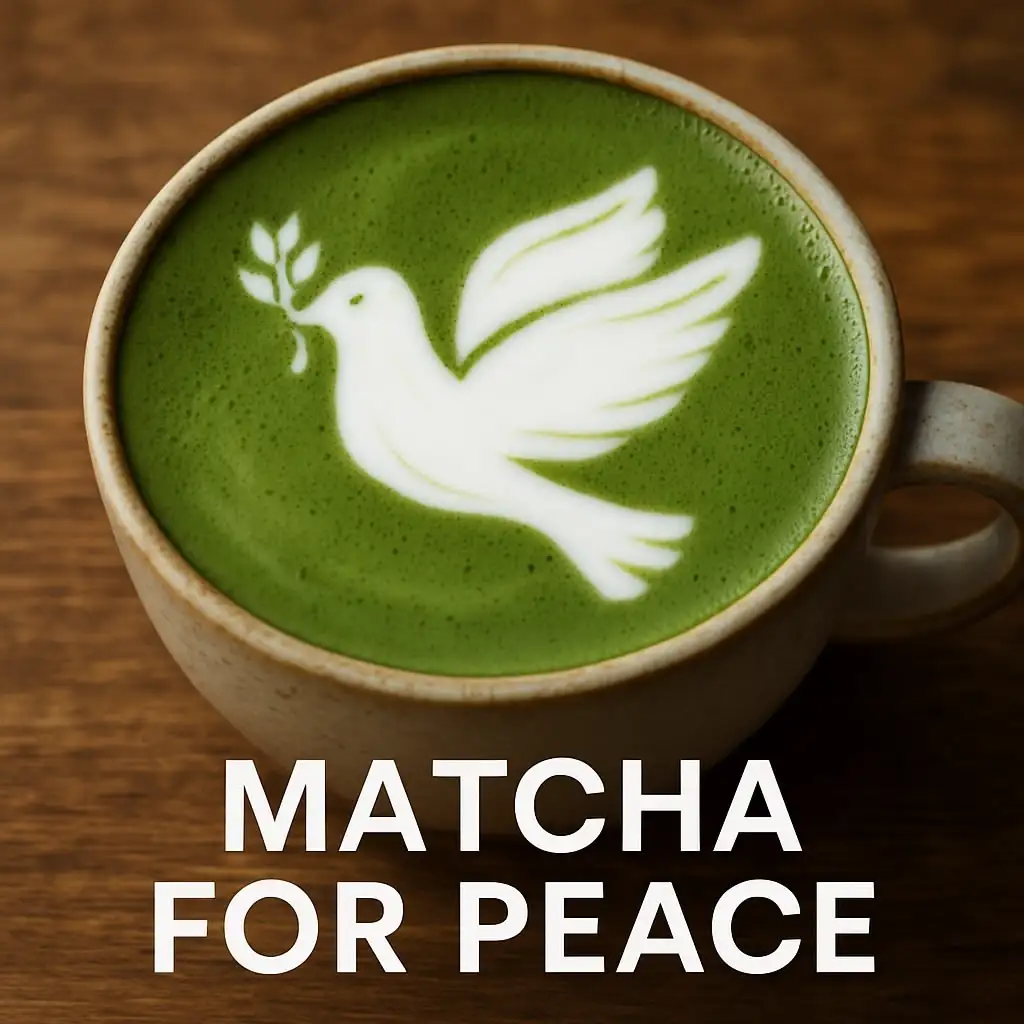
And how about a few videos…
Make It Real
Here’s how you can join us in this modern tea ceremony:
- Choose your “peace day” to skip matcha—I’m doing Wednesdays, but pick whatever works for your rhythm
- Donate to one or both organizations above (or any you trust). Set up recurring monthly donations if you can—$30/month covers your weekly skipped lattes and creates predictable funding for peace work
- Create your own ritual around this choice. Maybe it’s a moment of reflection about global suffering. Maybe it’s a prayer for peace. Maybe it’s just a quiet “thank you” for your own abundance and a hope that your small sacrifice contributes to someone else’s survival
- Share or don’t! This isn’t about grandstanding or virtue signaling. If posting fake matcha makes you smile and spreads the word, great. If you prefer to keep this private, that’s equally valid
- Stay connected to the impact. Follow the organizations you support. Read their updates. Let your weekly sacrifice keep you connected to global realities
A Final Word
Farmers in Japan taught me that the best matcha grows under controlled stress. Quality comes from integrity and patience in how you tend your fields.
Peace work requires the same controlled stress—the voluntary discomfort of caring about strangers, of giving up small luxuries for large principles, of choosing long-term hope over short-term comfort.
Peacemakers tend the fields of human dignity with that same patience. And like matcha farmers, they know the most important work happens in the shading—out of sight, in the careful cultivation, in daily choices most people never see.
So yes, I’m in the matcha business and I’m asking you to skip one latte a week. Because a global matcha shortage seems like the perfect time to drink less and give back globally to those facing unimaginable circumstances.
When I skip my Wednesday matcha and transfer that $7.50, I’m not “buying peace.” I’m saying someone else’s safety matters more than my routine. I’m joining a community that believes peace is possible—even when it’s hard, slow, and fragile.
It’s time again to use matcha for peace.
If you do this and wanna let me know, please do. I’d love to hear about it.